
Numerical
Concrete
Python
Why it matters
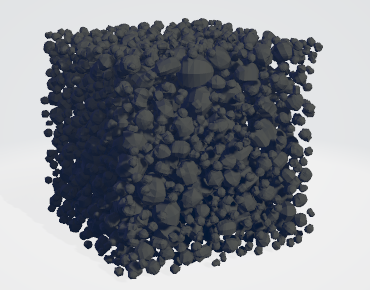
Generating random geometries of inclusions (the aggregates) that follow a given grading curve is far from trivial: in the literature, particle placement algorithms can become arbitrarily complex, especially when aiming for fast generation and/or realistic packing, with high volume fractions and no overlap between particles — and the two goals often conflict with each other. The project addresses this trade-off between speed and packing efficiency by developing and optimising randomisation algorithms to generate meso-scale inclusions, while also matching the most likely shape for the type of aggregate used.
What you'll do
- Develop and optimise randomisation algorithms in Python to generate the inclusions.
- Build meso-scale models from the generated geometries.
Prerequisites
- Basic programming skills are useful but not essential, you will learn during the thesis.
Tools
- Python, to write the randomisation and optimisation algorithms.
- Abaqus, to run FEM analyses on the generated geometries.
Supervisor
Prof. Gianluca Mazzucco · gianluca.mazzucco@unipd.it